Education
Geometry Learn V3: A Smart Way to Learn Geometry

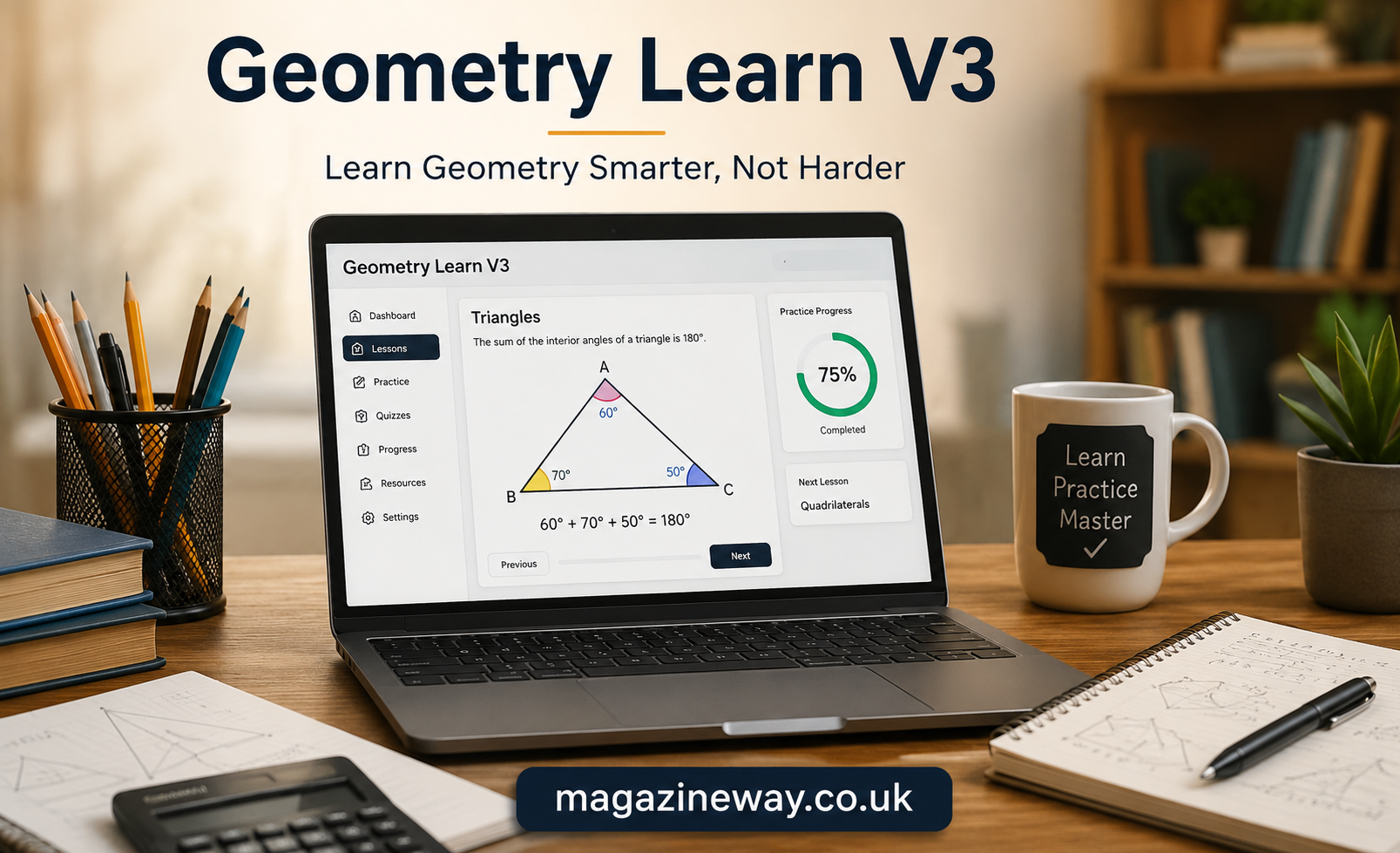
Geometry can feel difficult when students have to memorize formulas without understanding how shapes, angles, and measurements work together. Geometry Learn V3 offers a more visual and structured way to learn geometry, helping students understand concepts through examples, practice, and step-by-step explanations.
This guide explains what Geometry Learn V3 is, its main features, who can use it, and how its learning system works.
What Is Geometry Learn V3?
Geometry Learn V3 is a learning system designed to help students study geometry in a clear and organized way. It covers basic topics such as points, lines, angles, and shapes, along with more advanced areas such as circles, coordinate geometry, transformations, and 3D figures.
Instead of relying only on written formulas, the system focuses on visual learning, guided practice, and immediate feedback. This can make difficult concepts easier to understand and remember.
What Makes Geometry Learn V3 Useful?
The main strength of Geometry Learn V3 is its structured approach. Students can learn a concept, see how it works, and then practice it with different questions.
Its key features include:
| Feature | How It Helps |
|---|---|
| Adaptive Practice | Adjusts questions according to the learner’s progress |
| Visual Tools | Makes shapes, angles, and relationships easier to understand |
| Step-by-Step Help | Explains how to reach an answer instead of only showing it |
| Instant Feedback | Helps students identify mistakes quickly |
| Progress Tracking | Shows areas that need more practice |
| Topic Roadmap | Provides a clear path from basic to advanced geometry |
These features are especially useful for students who find traditional textbook explanations difficult to follow.
Main Topics Covered
Geometry Learn V3 can be organized into several important areas:
- Geometry Basics – Points, lines, angles, and basic shapes.
- Triangles and Polygons – Properties, similarity, congruence, area, and perimeter.
- Circles – Chords, arcs, tangents, and important circle relationships.
- Coordinate Geometry – Coordinates, distance, midpoint, and slope.
- Transformations – Reflections, rotations, translations, and dilations.
- 3D Geometry – Volume, surface area, and properties of solid figures.
- Proofs – Logical reasoning and step-by-step geometric arguments.
The topics build on each other. This helps students develop the knowledge needed for more difficult problems.
Who Can Use Geometry Learn V3?
Geometry Learn V3 can be useful for different types of learners.
- School students can use it for additional practice and revision.
- Homeschooling students can follow a structured learning path.
- Teachers can use it as supplementary practice material.
- Adult learners can use it to refresh their geometry skills.
- Test preparation students can use practice questions to strengthen weak areas.
It is most useful for learners who want to understand geometry instead of simply memorizing formulas.
How Does the Learning Process Work?
A simple learning cycle can make geometry easier:
Learn → Understand → Practice → Check → Improve
First, the learner studies the concept. Then, visual examples or explanations show how it works. After that, practice questions test the learner’s understanding.
If an answer is incorrect, feedback can help identify the mistake. The learner can then practice again before moving to a harder topic.
Why Visual Learning Matters in Geometry
Geometry is closely connected to shapes and space. Therefore, seeing a concept can often be more helpful than reading a long explanation.
For example, instead of only memorizing that the angles of a triangle add up to 180°, students can work with different triangles and observe how the angles change while the total remains the same.
This approach helps connect formulas with actual geometric relationships.
Our Analysis
Geometry Learn V3 is most valuable as a structured learning and practice approach. Its focus on visual explanations, progressive topics, and feedback can make geometry less confusing for students who struggle with traditional methods.
However, no learning system can replace consistent practice. Students still need to solve problems independently and understand why each answer is correct.
The biggest benefit comes when learners use the platform regularly instead of relying on it only before an exam.
FAQs
Q1. Is Geometry Learn V3 suitable for beginners?
Yes. Its structured progression starts with basic geometry concepts before moving toward advanced topics.
Q2. Can it help with geometry proofs?
Yes. Proof-related learning focuses on logical steps and relationships between geometric facts.
Q3. Is visual learning important for geometry?
Yes. Diagrams and interactive examples can make spatial relationships easier to understand.
Q4. Can teachers use Geometry Learn V3?
It can be useful as supplementary practice alongside regular classroom instruction.
Q5. Does practice improve geometry skills?
Yes. Regular practice helps students recognize relationships, apply formulas, and solve unfamiliar problems more confidently.
Conclusion
Geometry Learn V3 provides a clear way to approach geometry through visual learning, structured topics, practice, and feedback. Instead of focusing only on memorizing formulas, it encourages students to understand how geometric ideas connect.



 Automotive2 months ago
Do the Driving Modes in Cadillac Lyriq Offer Different Ranges or Battery Usages? Complete Guide
- Food2 months ago
Best Sonso Yuca Near Me: How to Find Fresh and Authentic Sonso de Yuca Nearby
- Food2 months ago
Best Cocido Gallego Near Me: How to Find Authentic Spanish Comfort Food
- Food2 months ago
Best Pollo al Chilindrón Near Me: Find Authentic Spanish Chicken Restaurants
- Food2 months ago
Best Ensalada de Arvejas y Jamón Near Me: Find Fresh and Authentic Pea and Ham Salad
- Biography1 month ago
Chris McClure: Biography, Career, Family, Achievements, and Why He Is Trending
- Food2 months ago
Arroz Con Leche Near Me: Find the Best Authentic Rice Pudding Near You
- Biography1 month ago
Ellie Costello Biography: Age, Career, Husband, Net Worth, Family & Life Story